
Draining a Waterbed – Part 2
Siphon vs. Drill Pump vs. Mains Water Pump
Draining a waterbed can feel like a major project. A standard waterbed holds anywhere from 300 to over 800 litres of water (weighing between 300 kg and nearly 800 kg!). Trying to move a frame or mattress with even a fraction of water left inside can easily tear vinyl seams, ruin flooring, or destroy internal fibre layers.
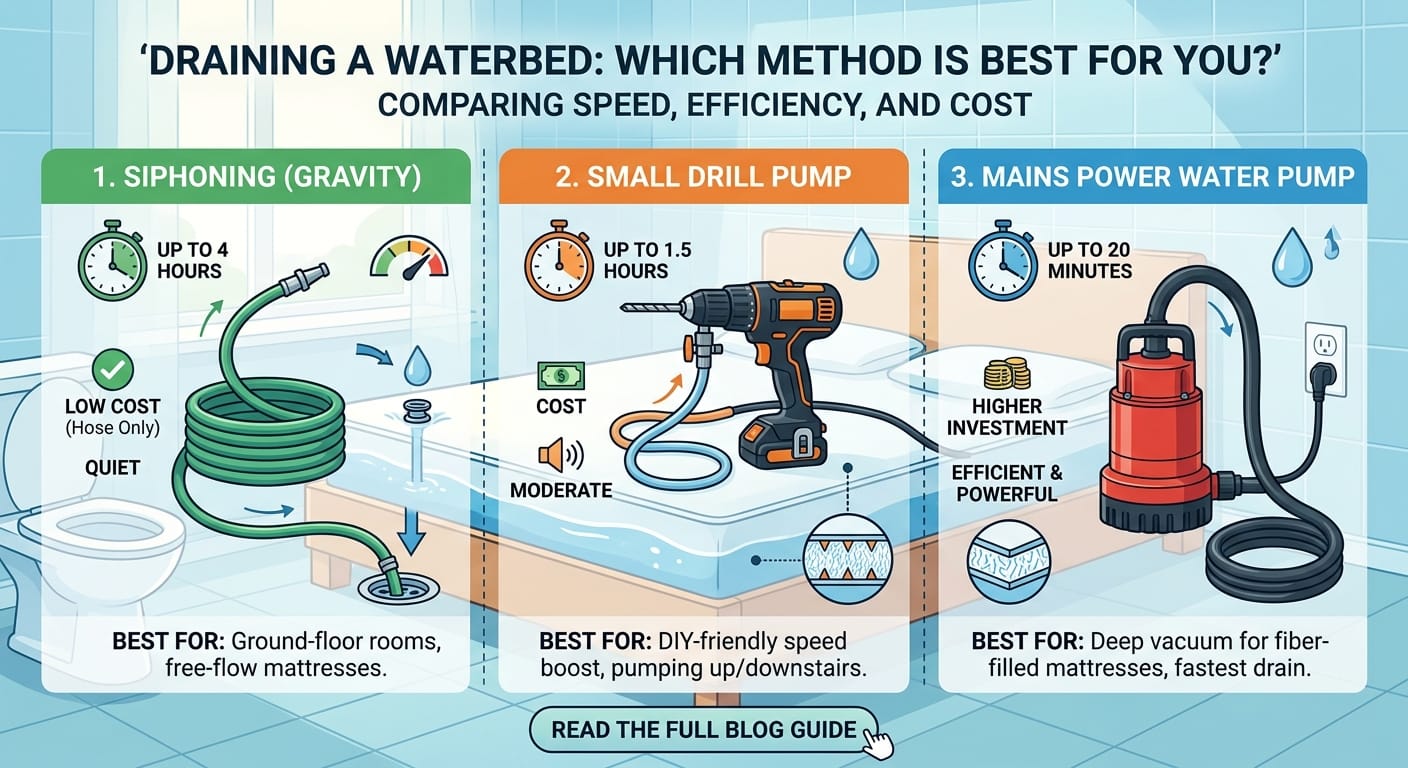
When it comes to getting the water out, your choice of equipment determines whether the job takes a full afternoon or just a quick 20-minute task. Here is a breakdown of the 3 main draining methods, their speed differences, and the pros and cons of each.
1. The 3 Draining Methods Compared
Option A: The Gravity Siphon
⏱ Drain Time: Up to 4 Hours
Siphoning relies entirely on atmospheric pressure and natural gravity. By connecting a hose from the elevated waterbed to a drain located lower than the bed (such as a ground-floor floor drain, toilet, or outside garden), water flows out without any electrical power.
Pros:
Zero Extra Cost: Uses a standard garden hose and cheap drain adaptor.
Silent & Safe: No noisy motors or risk of mechanical breakdown.
Cons:
Extremely Slow: Takes anywhere from 3 to 4 hours depending on hose length and diameter.
Strict Elevation Requirements: Will not work if your drainage point is on the same level or higher than the bed.
Weak Vacuum: Fails to create a strong pull, making it difficult to fully collapse internal fibre or baffle layers.
Option B: The Small Drill Pump
⏱ Drain Time: Up to 1.5 Hours
A drill pump is a small, inexpensive impeller attachment powered by a household electric or cordless power drill. Hose connectors attach directly to the inlet and outlet ports, transforming your drill into a lightweight liquid transfer pump.
Pros:
Budget-Friendly & Portable: Small, cheap tool attachment that fits in any toolbox.
3 x Faster Than Siphoning: Empties a typical mattress in 60 to 90 minutes.
Pushes Water Uphill: Can pump water up into sinks or higher drains.
Cons:
Strains Your Power Drill: Running a drill continuously for over an hour can burn out cordless batteries or overheat corded drill motors.
Loud & Constant Supervision Required: High-pitched noise for over an hour.
Prone to Priming Loss: Requires manual priming to start suction and can airlock if trapped air passes through.
Option C: Big Mains-Powered Water Pump
⏱ Drain Time: Up to 20 Minutes
A heavy-duty electric transfer or submersible utility pump plugs directly into a wall outlet. This professional-grade solution pulls water out rapidly with immense suction power.
Pros:
Ultra Fast: Empties a king-sized waterbed completely in 15 to 20 minutes.
Creates a Deep Vacuum: The powerful suction flattens internal fibre/baffle layers completely, locking them in place so the mattress can be safely folded without shifting or tearing.
High Head Pressure: Easily pumps water over long distances or up flights of stairs to outdoor drains.
Cons:
Higher Cost: Requires buying or renting a dedicated water pump unit.
Requires Close Monitoring: Empties the bed so quickly that you must stay by the valve to switch it off immediately when dry to protect the pump impeller.
2. Quick Performance & Comparison Summary
| Draining Method | Drain Time | Equipment Needed | Vacuum Pull | Best Suited For |
| Gravity Siphon | 3.0 – 4.0 Hours | Garden Hose, Waterbed Adaptor | Weak | Free-flow mattresses, ground-floor rooms |
| Drill Pump | 1.0 – 1.5 Hours | Power Drill, Pump Attachment, Hoses | Moderate | DIY moves on a budget, smaller mattresses |
| Mains Water Pump | 15 – 20 Minutes | Submersible / Transfer Utility Pump | Maximum (Deep Vacuum) | Fibre/baffle mattresses, fast moving days |
3. Step-by-Step Guide for a Successful Drain
Unplug the Heater (24 Hours Prior): Always turn off and unplug the heating pad at least 24 hours beforehand. Draining a bed while the heater is powered on will melt the vinyl or burn out the heating element.
“Burp” Trapped Air Out First: Before attaching any pump or hose, open the valve and gently roll a broom handle or smooth object from the head of the bed toward the valve. Removing trapped air pockets prevents airlocks and speeds up pumping across all methods.
Connect Your Adaptor & Hose: Attach a leak-proof waterbed drain adaptor to the valve and secure your hose line.
Run the Outlet Line: Place the output end of your hose into a ground drain, toilet, or outdoor garden area.
Engage Drainage & Monitor: Turn on your pump or start your siphon. Smooth out vinyl folds toward the valve as the water level drops to guide remaining water out.
Cap Valve Under Vacuum: As soon as water stops flowing, cap and plug the valve while the mattress is vacuum-compressed. This prevents internal baffles from shifting during transport.
Roll and Fold Smoothly: Roll the empty mattress from head to foot without creating sharp, hard creases that could weaken vinyl seams.
Draining a Waterbed – Part 2
Posted:
Last updated:
